

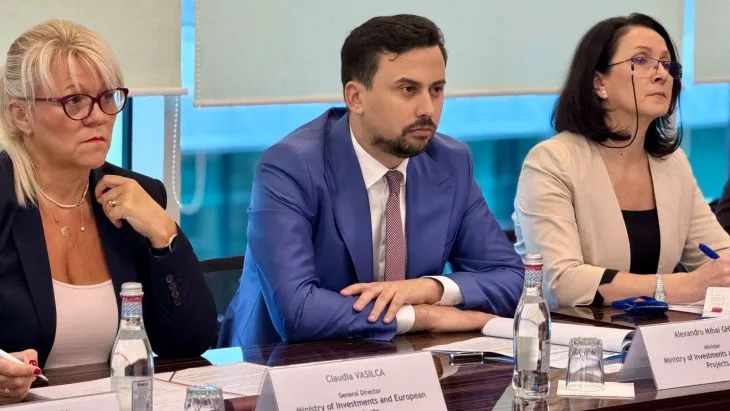
The Pact for Energy Education and the “Professor-Engineer Dimitrie Leonida” Center for Energy Studies are two essential initiatives for the future of the energy sector, stated the Minister of Investments and European Projects, Alexandru-Mihai Ghigiu, during the “Energy for Romania” event.
The Electrica Group and the Electrica Foundation, in partnership with the Atlantic Council, organized the second edition of the “Energy for Romania” event—Transatlantic Edition—launching a new development and training center for young energy professionals.
Ghigiu notes that the energy sector is undergoing a profound transformation—much like Romania itself—and emphasizes that people are a vital resource, without whom no investment can truly reach its full potential. “The energy sector is undergoing a profound transformation—much like Romania itself—and this shift is evident in the investments we make, the technologies we employ, and, above all, the skills we require. Yet, within this transformation, there is one resource without which no investment can truly reach its full potential: people. We can build grids, develop generation capacity, and introduce new technologies, but we need well-trained engineers, technicians, electricians, and specialists to translate these investments into tangible outcomes—results that benefit the community. That is why I believe the ‘Pact for Energy Education’ and the ‘Dimitrie Leonida’ Center for Energy Studies are significant initiatives—essential, I would even say—for the future of this sector. They are rooted in a simple yet vital premise: the training of specialists cannot be the sole responsibility of a single institution. Achieving results requires a collective effort involving companies, schools, universities, and public authorities. Education must be more closely aligned with economic realities and the actual needs of the labor market,” Ghigiu emphasized, as reported by Agerpres.
The official also stressed that young people must have access to practical internships and the expertise of seasoned professionals. “Professionals already working in the field must have access to continuous training opportunities, particularly to help them adapt to new technologies. As Minister of Investments and European Projects, I believe our responsibility does not end with the completion of projects. We must ensure that Romania also has a skilled workforce capable of carrying these projects forward. Our goal is not merely to build infrastructure; we also aim to develop the competencies required to utilize, maintain, and further expand this infrastructure in the long term. At the same time, the regional dimension of this center presents a unique opportunity. Energy challenges do not stop at national borders—and neither should collaboration, knowledge transfer, or the training of specialists. We need well-conceived investments, robust partnerships, and a long-term vision where infrastructure development goes hand in hand with human capital development. Ultimately, the true value of an investment is measured not only by what we build today, but also by the capacity we leave behind for future generations,” the official stated.