

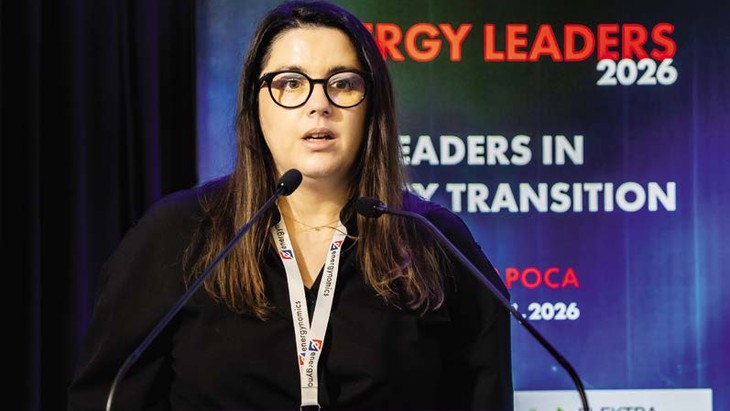
Elena Popescu, CEO of Elektra Renewable Support
In renewable energy projects, technical details overlooked during construction can lead to production losses and additional operating costs. Elena Popescu, CEO of Elektra Renewable Support, explains to Energynomics why the design of power plants with energy storage must take grid conditions into account, what prosumer monitoring could bring, and why technical aggregation needs at least one year of operation before its performance can be assessed using actual data.
You entered the renewable energy sector in 2009 and have worked across development, grid connection, construction, commissioning, operations and dispatching. Which stage changed your perspective on an energy project the most, and what do you see differently today compared with someone who views it primarily as an investment?
I have been through every challenge, from discussions on the ground to identify suitable locations to the finer details of grid connection and compliance with all requirements. I have experienced legislative changes and continuously adjusted our working methods. Today, all the requirements are readily available, documented and clearly explained. The documents issued for the development of a power generation facility contain far more information and references to ANRE orders than in the past. You just have to read carefully; and you have to listen, not merely hear. I cannot single out one particular aspect. When I read a document concerning a power plant, ideas and questions simply flow naturally.
Romania has moved from projects of a few megawatts to portfolios of hundreds of megawatts and gigawatts. What is the main risk if new capacity grows faster than the maturity of operations, the grid and flexibility mechanisms?
An interesting parallel would be a person skipping several stages of professional development and suddenly being promoted to a senior position in a company. The risk is that they may mishandle a crisis with a significant impact, making recovery more difficult and generating much higher costs. Market maturity therefore brings the major advantage of an objective perspective. Experienced people and organisations find solutions to problems more easily because they are much more likely to have encountered similar situations before.
You recently said that, in projects with energy storage, design should start with the needs of the grid, not the battery. What should an investor require from the EMS, the power plant controller and dispatching services to ensure that a hybrid asset performs well technically, commercially and from the system’s perspective?
Grid connection solution studies and technical grid connection approvals provide an X-ray of the grid node where the power generation facility will be connected. The design process and selection of the final equipment configuration can be compared to a CT scan or even an MRI. We start with the overall picture of the grid and analyse in detail what we need and what the technology allows us to do. What voltage level are we dealing with? High or low? Can our equipment meet the grid requirements at that connection point, taking all elements into account, including underground cables and transformers?
Your doctoral research focuses on the behaviour of aggregated units and solutions for renewable power plants and consumers. From both a research and practical perspective, how do you distinguish the commercial concept of a virtual power plant from genuine technical aggregation, and what conditions are still missing in Romania for aggregation to work at scale?
Everything is in place, both technically and legislatively, for operation in aggregated units (AUs). The real challenge lies in choosing the optimal solution from the perspective of commercial rules when the power generation facilities within an AU have different owners. We will have concrete data on the benefits for AU participants and additional revenues as operational experience accumulates. Today, we are discussing simulations conducted as part of research work. In practical terms, we will all know how a private AU performs only after at least one year of operating power generation facilities under technical aggregation. A full year must pass, covering all seasons, particularly if we are talking about an AU that includes every type of resource: wind, solar, gas, storage and controllable demand.
You have argued that prosumers should also be regarded as producers, with responsibilities towards the grid. How can this responsibility be introduced without slowing prosumer development, through technical rules, local control, storage and appropriate incentives?
Even something that happened a thousandth of a second ago belongs to the past and can no longer be changed. From the present moment onwards, we can influence outcomes. A minimal investment in integrating prosumers into DMS-SCADA systems, at least to measure active and reactive power, would greatly improve the calculations continuously performed to assess the state of the national power system. Facilities already commissioned could be accommodated through investment in metering equipment by the distribution system operator, if the necessary information cannot be retrieved from existing meters.
Elektra Renewable Support now operates a much larger and more diverse portfolio than in the early years of the renewable energy market. Based on your experience operating these assets, what are two or three decisions made during development that may seem secondary at the time but ultimately determine a plant’s availability, revenues or costs over its operating life?
Remote control of all switching equipment. Very often, remote control is provided only at the level of substations, not at the internal transformer stations. Disconnecting and reconnecting equipment therefore requires the local operator to intervene, even though production time lost through on-site switching operations could be minimised through remote commands. We may save a few tens of thousands during construction, but end up losing one, two or three hundred euros per MW generated in an hour, for a plant of more than 50 MW. Do the maths. Another component sometimes treated superficially during construction is the plant’s stormwater management and drainage system. During operation, numerous problems arise, particularly in rainy seasons, preventing the local team from intervening and making preventive maintenance schedules more difficult to carry out. The result: lost production, which means lost money. Moreover, additional investment in civil works becomes necessary after only a few years of operation.
Looking towards 2030, what three or four concrete signs would tell you that Romania’s power system has become genuinely more flexible and mature, capable of efficiently integrating renewable generation, storage and flexible demand?
People and their willingness to provide support are the most important sign. The experience gained over more than 15 years helps us find technical solutions more quickly. From the perspective of operational control through dispatching, we are seeing fewer restrictions and less grid congestion. If we compare the power limitations that plants received from us, through the local dispatch control centre (DLC), 5-10 years ago with those imposed today, we can see that grid improvements, although not always visible, are real and effective. Moreover, periods of congestion are anticipated. For example, during low-load periods, the DLC receives information on voltage levels established for each region to maintain grid stability. For me, the true maturity of the system will become evident when we can anticipate grid problems increasingly well, reduce interventions and restrictions, and integrate new capacity without compromising system stability.
_____________________________________________
The interview also appeared in the print edition of Energynomics Magazine, Q4 2026 issue.
In order to receive the printed or electronic issue of Energynomics Magazine, we encourage you to write us at office [at] energynomics.ro to include you in our distribution list. All previous editions are available HERE.