

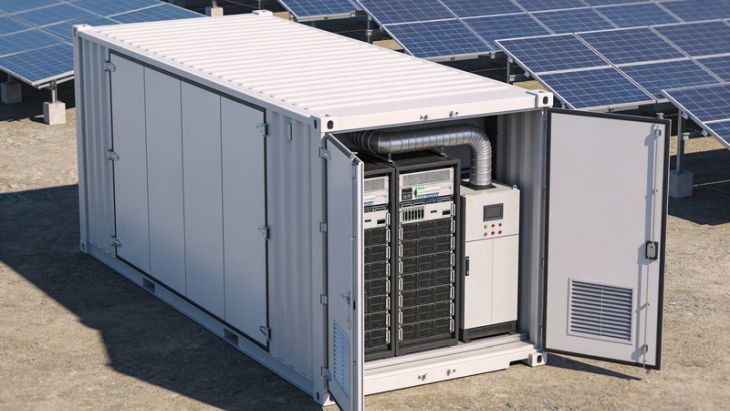
At a time when Europe is grappling with high energy prices, supply concerns, and the prospect of increasingly sweltering summers due to climate change, Bulgaria’s contribution toward a solution has earned it the nickname “Battery of the Balkans,” Reuters reports.
Bolstered by €700 million in non-repayable grants from the European Union, the neighboring country has doubled its battery storage capacity over the last year. This enables it to store solar energy generated during the day and feed it into the grid in the evening, during peak consumption hours. The result is a significant increase in Bulgaria’s electricity exports; the country supplied its neighbors during periods when heatwaves in July and August strained national grids, making it difficult to meet demand, according to Agerpres.
“Battery energy storage is essential today. It is not just an advantage; it is an absolute necessity,” stated Nikola Gazdov, president of the Association for the Production, Storage, and Trading of Electricity (APSTE).
For years, European Union member states have been working to develop battery storage systems to offset the intermittent nature of energy generated by solar and wind farms. Progress has been slowed by long waiting periods for obtaining regulatory approvals and grid connections, though the adoption of these technologies is expected to accelerate-particularly in Germany, the UK, and Italy. Events this year-where high energy prices fueled discontent, leading to social unrest-have further sharpened the focus on battery storage.
Bulgaria has limited domestic oil and gas resources, and its electricity production is significantly lower than that of many other EU member states. Nevertheless, the country managed to increase its electricity exports by 62% this year compared to last, reaching 3.5 terawatt-hours, according to data from APSTE. This growth was driven by European funding and legislative changes, which attracted private investment in battery energy storage systems.
Currently, Bulgaria’s storage capacity stands at approximately 6 gigawatts-double the 3 GW recorded a year ago.
A portion of Bulgaria’s energy exports was directed to Romania, which was forced to shut down a reactor at the Cernavodă nuclear power plant in August after drought conditions caused water levels in the Danube-used for reactor cooling-to drop. Beyond the value of exports, the increase in battery energy storage capacity in Bulgaria has also helped Romania maintain water levels in its reservoirs, reducing the need to rely on hydroelectric power-a resource traditionally used to meet peak consumption periods.
Bulgaria has exported as much as 50,000 megawatt-hours of electricity per day, stated Dimitar Zarchev, head of the Central Dispatch Office at Bulgaria’s Electricity System Operator. “To put things into perspective, this means an average of 2,000 megawatts leaving Bulgaria every hour-an amount comparable to the output of the Kozloduy Nuclear Power Plant,” says Dimitar Zarchev.