
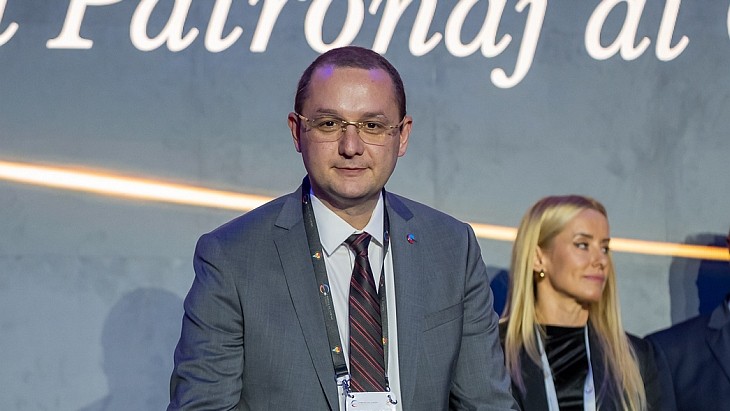
Alexandru Chiriță, CEO Electrica
In March, Electrica’s CEO spoke to Energynomics Magazine about targets: 1 GW of generation capacity and 900 MWh of energy storage by 2030. In December, he talks about what has been achieved. The year 2026 brought Alexandru Chiriță a new four-year term at the helm of Electrica, improved financial results and a five-year partnership with the Atlantic Council. Also in 2026, construction began on the Bihor 1 and Satu Mare 3 solar parks, the group obtained grid connection approvals for 19 storage projects and signed the contract for the new power plant in Craiova, while the historic wing of the National Technical Museum reopened after 40 years. The Pact for Energy Education, proposed by Alexandru Chiriță in June 2025, was signed on 16 November 2026 at the Filaret Power Station in Bucharest, alongside the presentation of the “Prof. Eng. Dimitrie Leonida” Centre for Energy Studies, under the High Patronage of the Romanian Government. Electrica’s CEO explains what connects these initiatives and why an energy company is setting up a school.
If you had to sum up 2026 in one sentence, what would it be?
In 2026, the plan became a construction site. We began construction of the Bihor 1 solar park, obtained grid connection approvals for 19 storage projects with a capacity of 780 MWh and signed the contract for the new cogeneration plant in Craiova. We got through a summer of drought without asking anyone to switch off the lights. On 28 March, together with the Electrica Foundation, we reopened the historic wing of the “Prof. Eng. Dimitrie Leonida” National Technical Museum, which had been closed to the public since 1985. In June, we signed a five-year partnership with the Atlantic Council in Washington, and on 16 November we signed the Pact for Energy Education in Bucharest.
If I had to choose one idea, it would be this: megawatts can be financed, people must be trained, and trust must be built. We have worked on all three this year, and my 8,000 colleagues know better than anyone what each has taken.
You have been given a new four-year term. What commitments are you making?
Three words I have used publicly many times: infrastructure, expansion and execution. Infrastructure, because the grid must be prepared for the electrification of industry, transport and homes. Expansion, because the target of 1 GW of generation capacity and at least 900 MWh of storage is a starting point, not a ceiling. Execution, because what stands between a good plan and a result is the discipline to deliver quarter after quarter.
On 1 January 2031, I want to be able to show what I have handed over: megawatts in operation, a modernised distribution grid and trained people.
Megawatts can be financed
2025 was a record year, with net profit exceeding 1.2 billion lei. In the first half of 2026, profit rose another 8.6%. Is the rebound over?
The leap is over, but the new level remains. In 2025, we recorded net profit of 1.22 billion lei and EBITDA of 2.38 billion lei, the best results in the company’s recent history. Part of that came from the end of the price-cap scheme, which had weighed on our supply business for years. In the first six months of 2026, EBITDA again exceeded one billion lei, while net profit reached 457.5 million lei, above the figure for the same period last year.
No company can grow by 159% every year, nor should it. What matters to an investor is whether the new level can be sustained and whether the money goes back into the grid. Our regulated asset base reached 8.7 billion lei by mid-year, and Fitch reaffirmed our credit rating and stable outlook.
I did not produce these figures. They were produced by the people in our control rooms, substations and customer service offices.
Financial figures do not keep the lights on. What has changed for the grid and its customers?
Power cuts have become less frequent. In 2025, the average number of interruptions fell to 1.88 per year, almost 13% fewer than the previous year, while their average duration declined to 220 minutes. These are not figures to boast about. They are figures we work to improve, substation by substation, and behind every minute saved is a team that reached a fault more quickly.
Our customers have changed, too. At the end of 2025, we had almost 120,000 connected prosumers, 58% more than a year earlier. A grid designed to carry electricity in one direction now carries it in both. That requires new transformers, automation and smart meters. Above all, it requires people who know how to operate and adjust them.
This year, we also commissioned Romania’s first system to manage a building’s energy consumption using artificial intelligence, developed together with a Romanian start-up and the Technical University of Cluj-Napoca. The second building where it operates is the Technical Museum. But in the end, it is an electrician who switches on the light.
This summer, with Unit 1 at Cernavodă shut down, you publicly urged factories to shift production to midday. What did the crisis reveal?
It showed that demand flexibility is no longer just a conference topic. On 28 July, Unit 1 at Cernavodă was shut down because of the Danube’s water level, leaving the system dependent on imports in the evening. At midday, we had more solar electricity than we could use. In August, we launched the “Keeping Romania Lit” programme: the active electricity that an industrial customer shifted from evening hours to midday was provided free of charge for four hours a day, measured by the smart meter and reflected in the bill.
I said at the time that a family can switch off a light, but a factory can move a mountain. The lesson goes beyond one summer. A system with abundant solar generation needs three things to get through eight o’clock in the evening: storage, grid infrastructure and customers who can shift their consumption. We are building the first two. The third has to be learned, and the companies that learned it in August will have an advantage every summer from now on.
In March, you spoke of reaching 1 GW by 2030. At the time, you had only a few dozen megawatts in operation. Is the target still realistic?
Yes, and I can back that up with figures. In March, we had 307.5 MW either operating or at advanced stages of development. The Vulturu and Satu Mare 2 solar parks are already generating electricity, and in May we signed the construction contract for the 78.8 MWp Bihor 1 solar park, which also includes storage, as well as the contract for the 62.5 MWp Satu Mare 3 project. The road to 1 GW is not a short one, and I am not pretending otherwise. What I am saying is that we are pursuing it through our own development activities and mature projects, without chasing megawatts at any cost. A project enters our portfolio because it delivers returns, not because it looks good in a presentation.
The difference between a strategy and a plan is that a plan has permits, land, contracts and deadlines. Behind every megawatt we announce is a public document filed with the Bucharest Stock Exchange that anyone can check. For a listed company, that is the only form of promise I accept. The rest are intentions, and intentions do not generate electricity.
And storage? Everyone is installing batteries. Don’t you risk entering an overcrowded market too late?
The risk exists for anyone who treats storage as a standalone bet on a single revenue stream. We see it as part of the grid and our wider portfolio. We are working on nearly 170 MWh of storage capacity at Fântânele, as well as storage systems associated with our solar and wind farms. We have proposed to shareholders a portfolio of up to 800 MWh across distributed sites, with an investment of no more than 185 million euros. These include 19 projects totalling approximately 780 MWh, for which we have obtained grid connection approvals and which we intend to commission by mid-2028. The General Meeting of Shareholders was convened for 10 December.
A battery installed next to a substation can serve several purposes: it smooths the generation profile of our renewable plants, reduces exposure to imbalances, helps maintain voltage in areas with growing numbers of prosumers and enables the grid to accommodate new generation capacity. In a market with many batteries, the winners will be those who can put the same battery to several uses. Those who have grids also have places where storage can deliver real value.
You have spoken of investing 2 billion euros in the grid over ten years, yet you also say that is not enough. Who pays?
Ultimately, over time, those who use the grid pay for it. Our responsibility is to ensure that every leu translates into better service quality. In 2025, we commissioned distribution investments worth 878 million lei, while our 2026 investment programme, at 1.48 billion lei, is the largest in the company’s history. Our publicly stated target is 2 billion euros over ten years. On 10 December, shareholders will also vote on financing of up to 355 million euros from the European Investment Bank, specifically for grid investments in 2027-2030.
I have said openly that this is not enough and that the plans need a more ambitious target. A grid is built to last for decades and paid for over decades, under rules set by the regulator. We do not decide the tariffs. We decide how well we spend the money.
The most expensive grid is the one that is not there when you need it. A delayed factory, a solar park waiting for a grid connection or a neighbourhood suffering voltage drops costs more than a substation modernised on time. That is why I said in October that the grid must be built before the factory, not after it, and proposed a permanent dialogue between the energy sector and industry.
You said this summer that Electrica had become more than a distribution and supply company. What is it today?
It is a group that generates, stores, distributes and supplies electricity, and in 2026 it is also entering cogeneration. In Craiova, we won the tender for a 12-year concession, and on 24 August we signed the contract to build a new high-efficiency cogeneration plant, designed to be hydrogen-ready. It will eliminate coal from the heating supply of approximately 53,000 homes and institutions.
In February, we also signed a memorandum for up to 500 MW of photovoltaic and storage capacity at the Galați steelworks site. These are different projects, but they follow the same logic: bringing energy to where the economy needs it, with solutions suited to each location.
But I do not want to confuse scale with direction. I have publicly defined our direction: Electrica will become Romania’s Factory of Light. The name comes from the Filaret Power Station, Bucharest’s first municipal power plant, which began operating in 1908. For me, it has a practical meaning. A utility waits for demand and serves it. A factory of light builds ahead of demand: grid infrastructure, generation, storage and the people who keep them running.
What could stop you from reaching your 2030 targets?
The biggest risk is not financing, but time. Money can be found for a good project. We saw that with our green bonds, and we see it with the European Investment Bank. Time is lost elsewhere: in lengthy permitting procedures, equipment with long delivery times and rules that change along the way. I do not control those factors, and I cannot promise that everything will fall into place. I can only promise that we will report them promptly when they arise.
There is another risk that the sector talks about far too little. We could have the permits, equipment and financing in place and still be stopped at the final stage because there is nobody available to carry out the work or formally accept it upon completion. Of all these risks, this is the only one we can reduce ourselves. That is why I have placed education on the same level as investment, rather than relegating it to a corporate social responsibility report.
An investment plan without a workforce plan is just a shopping list.
People must be trained
What was signed on 16 November?
The Pact for Energy Education was signed, and the “Prof. Eng. Dimitrie Leonida” Centre for Energy Studies was presented, under the High Patronage of the Romanian Government. The Pact contains five commitments and one rule: each signatory defines its own contribution, with a measurable outcome, a deadline and a person responsible. Once a year, we will publicly report what has been achieved. The Pact is a public promise, not a contract. Joining is free and creates no financial obligations.
I proposed the Pact to the sector in June 2025, and we signed it on 16 November 2026 at the Filaret Power Station. Between those two dates, we spent a year and a half talking, in turn, to companies, universities, high schools, state institutions and trade unions.
The reason comes down to simple arithmetic. A solar park can be built in one or two years. A battery can be installed in a matter of months. A skilled electrician needs four years of schooling and several more years of practical experience alongside someone who knows the trade. A student who entered ninth grade this autumn will finish high school in the summer of 2030. The electrician of 2030 is a student today. That is why I say that 2030 begins in the classroom.
The signing venue carries the same message. The power station opened in 1908, the same year Dimitrie Leonida established Romania’s first school for electricians and mechanics. We want to honour his memory and establish a “school of schools” for the energy sector.
Why is an energy company setting up a school? Isn’t that the state’s responsibility?
It is the responsibility of everyone who needs these people, and we need them more than anyone. Electrica distributes electricity across 18 counties, covering more than 40% of Romania’s territory, and serves over four million consumers. The people maintaining this grid today are 48 years old on average, and from 2030 onwards, we will need to recruit 300 new people every year. A company that needs to modernise substations, connect prosumers and build new capacity cannot afford to wait for somebody else to solve the problem.
The state has its role and has accepted it: the Centre operates under the High Patronage of the Government. But no law can train an electrician. That takes a school, an experienced tradesperson and a company willing to provide practical training. I chose to take the initiative and invite everyone to join, rather than wait for somebody else to start. Ultimately, though, who makes the proposal matters less than who delivers.
What exactly is the Centre, who funds it, and what is your role?
The Centre is where the energy sector will train its people, through two distinct pathways. The first focuses on grid-related trades: electricians, installation technicians and people who work on power lines and in substations. The second focuses on energy regulation, through a small, selective programme for those who draft and implement the rules. The Centre is open to the entire region. A young person from Chișinău or Kyiv will have the same opportunity to enter as someone from Cluj or Athens.
The Pact identifies the Centre as the platform through which its objectives become programmes for training, practical experience, research and regional cooperation. The Electrica Foundation will support its launch. Other signatories will contribute what they can: practical training placements, specialists who can teach, scholarships and laboratory equipment. I am not putting figures on these contributions because a number announced before the first course begins is an uncertain promise, and I would rather be judged by results.
My role is that of initiator, nothing more. A school becomes a strong institution on the day it can function without the person who established it. The Centre bears the name of a professor. It does not even bear the name of a company.
Trust must be built
On 16 November, at the Filaret Power Station, you organised the second edition of “Energy for Romania”. Why is a distribution company hosting a forum with the Atlantic Council and BloombergNEF?
Because the region’s energy security is being discussed anyway, and the question is whether Romania has a seat at the table or finds out from the press what has been decided.
The first edition, in October 2025, was a dialogue among Romanian participants. The second brought American and European partners, the Government, companies from the sector, universities and schools into the same hall for a day. In the morning, we signed a pact about skilled trades. Then the Atlantic Council presented its report on the Vertical Energy Corridor, BloombergNEF analysts showed what the regional market looks like, and companies, the regulator and banks discussed prices, capacity and grids.
You cannot talk credibly about energy corridors if you have nobody to operate a substation. And conversely, a good electrician deserves to know that their work is part of something bigger than a county. “Energy for Romania” is where the two conversations meet once a year.
It is not a company event about the company itself. It is a table to which we have invited everyone, including our competitors across all segments. Beyond our individual business plans, the goal is shared: the energy security of Southeast Europe.
The partnership with the Atlantic Council, signed in Washington in June, runs for five years. What does Electrica actually gain?
It gains a seat at the table where our region is discussed and written about, rather than merely being the subject of those discussions. We signed the agreement on 10 June in Washington with Frederick Kempe, President of the Atlantic Council, one of the best-known American public policy organisations. Under the agreement, Electrica is a founder of Atlantic Council Romania, holds a seat on its advisory board and is a founding partner of the report on the Vertical Energy Corridor.
I said at the time that we had not come with a request, but with a contribution. A company operating electricity grids in 18 counties has knowledge that a policy institute does not: what a grid under pressure looks like, what a summer like this one means, and how long a grid connection actually takes. In our region, a resilient grid is not just infrastructure. It is defence.
A five-year partnership goes beyond any communications campaign and must be judged by what it produces. The first result is a public report that anyone can read and criticise.
So far, the Vertical Corridor has largely been a discussion about gas. What does it have to do with electricity?
That is precisely our contribution: electricity needs to have a seat at the same table as gas. When we talk about the region’s energy security, we usually think of pipelines and terminals. But an electrifying economy increasingly depends on power lines, interconnections, storage and the people who operate them. The summer of 2026 showed how quickly circumstances can change when drought forces a nuclear reactor offline. On an evening like that, every interconnection and every megawatt that can be shifted from one hour to another matters.
I do not comment on anyone’s gas contracts. That is not the business of an electricity company. Our job is to demonstrate, with data, what a grid that is ready for the future looks like: connection capacity, flexibility and links with neighbouring countries. I said this year that, by 2050, value in the energy sector will shift from volumes to the management of access, flexibility and continuity of supply. An energy corridor that fails to account for that is being designed for yesterday’s economy.
You reopened the historic wing of the Technical Museum after 40 years. What is an energy company doing in a museum? Some would argue that the money should have gone into the grid.
The grid has its own budget, approved by the Board and reported to the stock exchange. The museum is something else, and I will defend it without hesitation.
The National Technical Museum was founded in 1909 by Dimitrie Leonida, the man who trained Romania’s first electricians. Its historic wing was closed to the public in 1985 after the roof collapsed. For forty years, entire generations of children walked past a locked door.
In the autumn of 2025, while preparing the first edition of “Energy for Romania”, I visited the museum with my son. With the honesty of a four-year-old, he asked me why I did not repair it. He was right. It really was that simple: a choice between doing something and doing nothing. I promised him I would do it and, on 28 March 2026, together with the Electrica Foundation and the museum’s team, we reopened the historic wing.
What is an energy company doing there? Looking for its future employees. A child who sees a generator, a watermill or the first Romanian computers might develop an interest in a technical career. A child who sees a locked door learns that technology is something we once had. I cannot think of a recruitment investment with a longer time horizon. And there is still work to do there: this was the first stage, not the last.
Also in 2026, you restored the lunar module at the museum. What is it, and why does it matter to an energy company?
It is a life-size replica of the Apollo lunar module, donated to Romania by the United States Embassy in February 1973, in the midst of the Cold War. The handover record, dated 3 March 1975, also notes the autograph of Eugene Cernan, the last man to walk on the Moon. It was assembled at the Technical Museum, and generations of children dreamed in front of it. We found it again, covered in dust, and I said at the time that it deserved better. This year, we restored it.
It matters for two reasons. The first has to do with this year: in Washington, I saw the original lunar module at the Smithsonian, under the spotlights. A gift made to Romania half a century ago deserves to look just as good in Bucharest. The second reason is simpler. A replica of a craft built to take people to the Moon tells children that engineering can achieve anything. A country that needs electricians, engineers and dispatchers cannot afford to keep such an object under a tarpaulin.
And the Filaret Power Station? You have held two editions of the event there. What comes next?
We are going to bring it back to life, step by step, and I have said publicly that we will. The power station began operating in 1908 as Bucharest’s first municipal power plant. It has a 120-metre-long hall with steel trusses of a kind nobody builds today. It stood unused for a long time. In the past thirteen months, it has hosted two editions of “Energy for Romania” and the signing of the Pact.
I do not give deadlines I cannot meet or talk about budgets that have not been approved. But I can say why it matters. The museum shows where we come from. The power station can show where we are going. Between them lie a hundred metres and a hundred years. A listed company with four million consumers that brings its sector together in the building from which Bucharest received its light says something about continuity without raising its voice.
The man and what comes next
Megawatts, a museum, a power station, events, a magazine cover. Where does the company end and your personal project begin?
It is a fair question, and the answer can be verified. Remove my name from everything we have discussed and see what remains standing. The museum is open to the public and does not bear my name. The Pact is backed by companies, institutions and schools, while the Centre bears Dimitrie Leonida’s name and operates under the Government’s High Patronage. The Atlantic Council partnership belongs to Electrica. The investments remain with the company, and Romania is the beneficiary.
If I had wanted a personal project, I would have put my name on it and kept a position within it. I have done nothing alone. Behind every initiative are colleagues, partners and signatories, and they can confirm that. My involvement in these projects ends with my term in office, whenever that may be. A school, a museum and a grid remain. What matters to me is what lasts.
You asked the young people in Shadow Volt to become ctitori, a Romanian word associated with those who found and build institutions for future generations. It carries strong cultural connotations. Does it belong in the vocabulary of a CEO of a publicly listed company?
The word expresses exactly what is missing from our management vocabulary. We have words for those who own something and for those who manage it. We lack a word for someone who builds something knowing from the outset that it will not belong to them. Romanian has had that word for centuries: ctitor.
In energy, this is not just a figure of speech. The grid we operate today was built by people who never knew us. The grid we are building now is intended for people we will never know. A substation lasts forty years. A term in office lasts four. The only honest way to do this job is to build something you will eventually hand over.
The Pact asks the same of an entire sector. Every signatory gives something of its own: time, practical training placements, specialists, for people who may never work for it. In a cost spreadsheet, that looks like a loss. In a country, that is how you build a school.
I asked the young people in Shadow Volt, our internship programme this year, for just one thing: to leave behind something they had built, something another person could take forward. Not simply a certificate. At twenty, it is good to learn that the things that matter do not end with you.
My boys still stumble over the word. I am in no hurry. It is a word you grow into.
What do you hope to present in December 2027, perhaps in another conversation?
Things that can be counted. The storage capacity for which we have obtained grid connection approvals: our stated intention is to have it operational by mid-2028. New megawatts of generation capacity, beyond what we have today, with each step reported to the stock exchange. Modernised substations and installed meters, delivered in line with our investment programme and beyond. At the Centre, the first courses. And the Pact’s first public report, in November 2027, in which every signatory explains what it has delivered against its commitments. There is another measure I am personally following: how many students choose an energy-related high school programme in the autumn of 2027.
I cannot promise that everything will be delivered on schedule. I can promise that we will report promptly what has been achieved and what has not. For Electrica, the story began again in 2022 with a promise. It continued on 16 November with a commitment. In 2027, you will find me where things actually get done: on the construction site.
What do you ask of this magazine’s readers, the people in the sector?
As for the people working in the energy sector, I invite them to join us. The Pact remains open, and anyone who signs later signs the same text. Participation is free, and the Electrica Foundation maintains the register of signatories. A company can offer practical training placements to students, send a specialist to teach a few hours a month or fund a scholarship. A high school can open an energy-focused class. A university can recognise a training programme. Each of these steps requires just one person within an organisation willing to stand up and say, with their name attached: I will take responsibility.
I ask one more thing of the industrialists reading these pages: tell us in good time where and when you will build, so that the grid gets there before the factory. I know that every company in this magazine has its own investment plan. I suggest adding a page to it: where the people will come from. We cannot solve the shortage of people by taking them from one another.
Megawatts can be financed. We have all seen that it is possible. What remains is for us to train, together, the people who will keep them running.
_____________________________________________
The interview also appeared in the print edition of Energynomics Magazine, Q4 2026 issue.
In order to receive the printed or electronic issue of Energynomics Magazine, we encourage you to write us at office [at] energynomics.ro to include you in our distribution list. All previous editions are available HERE.