
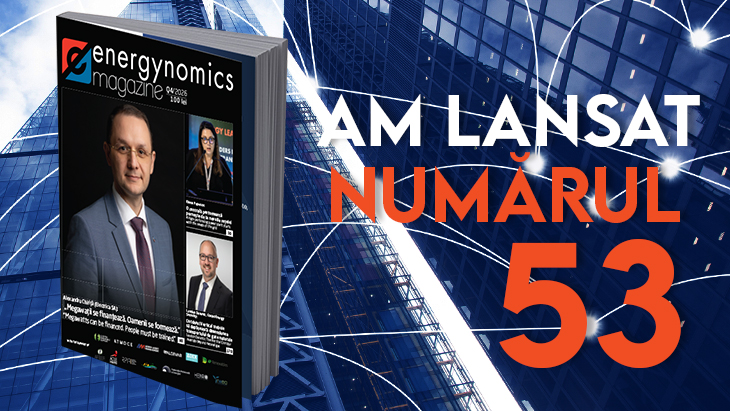
Issue 53 of Energynomics Magazine has been released and is available online, free of charge, along with all previous editions. The Q4/2026 issue brings together interviews, analyses and opinions on energy developments in Romania and the wider region, covering topics from energy storage, grids and financing to natural gas, district heating and cybersecurity.
ENERGYNOMICS MAGAZINE ONLINE
After years in which the energy sector focused mainly on projects and deadlines, followed by the work of turning plans into reality, 2027 could be the year when investments begin to visibly transform the operation of Romania’s power system, writes Gabriel Avăcăriței, Editor-in-Chief of the magazine, in his editorial. Mintia and Iernut are expected to add flexible generation capacity, Black Sea gas to strengthen domestic energy resources, and new renewable capacity, particularly battery storage, to reduce vulnerability during hours of supply shortages. The timetable remains vulnerable to delays, and stability does not automatically follow every megawatt connected to the grid. Nevertheless, the system’s foundations are growing stronger.
For companies, the test will be different: not simply producing more energy, but extracting greater value from it. Prices during surplus hours, imbalance costs, and access to the grid and energy markets will put pressure on business models. Flexibility, contracts and intelligent portfolio management will matter at least as much as investment in equipment.
Highlights from this issue
 The interview with Alexandru Chiriță, CEO of Electrica, reviews 2026 through a central idea: megawatts can be financed, people can be trained, and trust must be built. After discussing the company’s targets in the March issue of Energynomics Magazine (1 GW of generation capacity and 900 MWh of storage by 2030), Electrica’s CEO explains what has been achieved since then: a new four-year mandate, a five-year partnership with the Atlantic Council, and the Energy Education Pact, signed on 16 November 2026 at the Filaret Power Plant in Bucharest, alongside the presentation of the “Prof. Eng. Dimitrie Leonida” Centre for Energy Studies. For Alexandru Chiriță, the greatest risk between now and 2030 is not financing, but time. A second, less frequently discussed risk is the shortage of people to carry out the work: from 2030 onwards, Electrica will need to recruit 300 new employees every year. READ MORE!
Elena Popescu, CEO of Elektra Renewable Support, explains why the design of an energy storage project should start with the needs of the grid, rather than the battery itself. Grid connection studies and technical connection approvals provide an X-ray of the grid node where the power plant will be connected, while selecting the final equipment configuration is more like performing a CT scan or even an MRI. Regarding technical aggregation, Elena Popescu says that everything is in place from a technical and legislative perspective, but concrete evidence of the benefits for participants and additional revenues will emerge through operating experience. Understanding how a privately aggregated unit performs will require at least one full year of operation, covering all seasons. The interview also explores the potential benefits of prosumer monitoring. READ MORE!
Landon Derentz, Senior Director and holder of the Morningstar Chair for Global Energy Security at the Atlantic Council’s Global Energy Center, argues that Central and Southeastern Europe can turn its strategic position and energy resources into lasting economic advantages. The Vertical Corridor should evolve beyond natural gas transportation towards a more integrated regional energy market that supports industrial competitiveness, electricity infrastructure and emerging technologies. The main obstacles are political, regulatory and commercial rather than technological. Landon Derentz also examines the rising costs of protecting critical infrastructure and the new strategic dependencies associated with electrification, artificial intelligence and global technology supply chains. READ MORE!
Beyond the cover stories, the issue offers perspectives on financing through interviews with Cătălin Cepișcă and Sînziana Enache (Raiffeisen Bank), and Radu Hanga, President of the Bucharest Stock Exchange. Energy storage is explored with Favi Stelian (Nofar, which targets 2.24 GWh of storage capacity in Romania over the medium term) and Cosmin Cheran (Think Blu Solution). Grid developments are discussed by Mihai Pește, General Manager of Rețele Electrice România, and Ondřej Šafář, Country Manager of Evryo Group and CEO of Distribuție Oltenia, who addresses the integration of approximately 65,000 prosumers. Corneliu Bodea, CEO of Adrem and President of CRE, expects Romania to regain its status as a net electricity exporter in 2027.
Also featured in this issue: Iva Petrova, Bulgaria’s Minister of Energy, explains how the neighbouring country has accelerated investment in battery storage; the 400 kV Vulcănești-Chișinău power line has been energised, with its official inauguration taking place on 8 November 2026; Alexandru Ana, CEO of Optimizor, discusses cybersecurity in the energy sector, where essential entities have been required to carry out 218 controls since 27 August; and Christina Verchere, CEO of OMV Petrom, provides an update on the Neptun Deep project, where eight of the ten wells have been drilled and completed, with first gas expected in the first half of 2027. The issue also includes interviews with Erik Sagiyev (KMG International, Rompetrol), Nicolas Richard (ENGIE Romania), Adrian-Mircea Teodorescu (Termoenergetica) and Daniel Vasile (Daikin Romania), among others.
In her editorial, Varinia Radu, Founding Partner & CEO of Energynomics, outlines plans for 2027, including studies on energy storage, renewables and energy for industry, as well as small, invitation-only gatherings under the Energy House concept and further development of the WATT’s Next podcast series. The commitment remains unchanged: editorial independence, professional integrity and rigour in everything we deliver. In its 15th year, Energynomics continues to stand alongside the industry as it enters a new phase in which economic competitiveness, electrification and energy efficiency require solutions, not just debates.
You can access all previous issues in digital format HERE.
If you would like to suggest a topic or propose an editorial or advertising collaboration, please contact us at [email protected]. For subscriptions, please use the same email address.
