

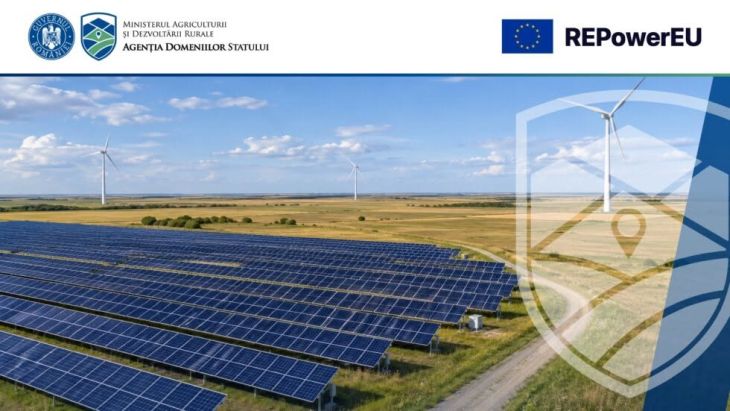
The State Domains Agency has completed the REPowerEU Reform of PNRR, so that over 32,000 hectares of unproductive land are available for investment in renewable energy, the Ministry of Agriculture and Rural Development (MADR) announced on Thursday.
“The Ministry of Agriculture and Rural Development (MADR), through the State Domains Agency (ADS), announces the successful completion and full absorption of the funds allocated for Reform 1 under Component 16 – REPowerEU, financed by the National Recovery and Resilience Plan (PNRR). The project, carried out between June 14, 2024 and August 31, 2026, benefited from a non-reimbursable European budget of 3,011,752 euros,” a statement from the MADR said.
All three milestones assumed by the PNRR (508, 509 and 510) were achieved on time. The most important strategic result is the identification and delimitation of 32,074.79 hectares of land suitable for major investments in renewable energy (solar and wind), selected from a total of over 84,000 hectares rigorously evaluated through pedological and agrochemical studies, the cited source states.
“The measure comes to support the national objectives of energy security and independence through a clear principle of economic responsibility: protecting fertile agricultural land. Thus, the areas designated for green parks are exclusively degraded, poorly productive (quality classes IV and V) or unproductive land from the state’s heritage. Through this approach, productive agriculture is not affected, but the energy potential of areas that did not offer agricultural yield is capitalized on, simultaneously with the digitalization and complete endowment of the state’s control capacity,” the press release states.
The Ministry of Agriculture presents, in the document, the concrete results of the three PNRR milestones achieved.

Thus, on Milestone 508 – State-of-the-art technical equipment and green mobility, the operational capacity of ADS in the field was consolidated and modernized by purchasing 4 100% electric utility vehicles for inspections, monitoring and field trips. At the same time, high-resolution geospatial equipment was purchased: professional drones and RTK stations for high-precision topographic measurements, and the IT infrastructure was modernized. Technical personnel were trained in the use of new digital technologies.
On Milestone 509 – Predictability and transparent legal framework, the regulatory framework necessary to attract private capital and accelerate procedures was created by adopting Law no. 159/2026 regarding the privatization of companies that manage public and private state-owned lands for agricultural purposes and the establishment of the National Authority for the Administration of State Domains, Fisheries and Aquaculture and the issuance of MADR Order no. 208/2026, the regulatory act through which the 32,074.79 hectares (classes IV-V and non-productive) were officially designated as suitable sites for photovoltaic and wind projects.
On Milestone 510 – National mapping and operationalization of the RUITN Register, 84,358 hectares were analyzed in detail through 260 pedological and agrochemical studies at the level of administrative-territorial units and 40 county studies. The RUITN Registry was also operationalized, an IT platform integrated with the GIS system (Urbis Web Server 2.0) that allows the collection, processing and centralized management of geospatial data, providing the state with an accurate, transparent and real-time record of land assets.
“By completing this reform, the State Lands Agency is transforming its way of working: public land management decisions are now based on rigorous geospatial data and advanced digital tools, while also creating the premises for attracting green investments without endangering the country’s productive agricultural areas,” the Ministry of Agriculture’s press release also states.
