

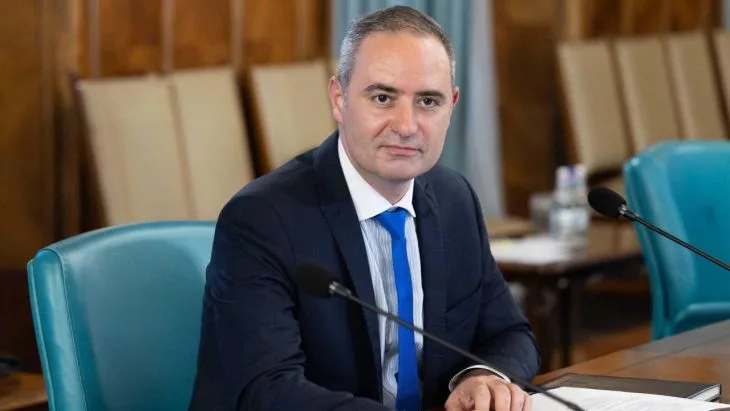
The problem on the fuel market today is no longer just how much fuel costs, but whether there is enough product available, believes the interim Minister of Finance, Alexandru Nazare.
He specified that the intervention of the authorities in the market should not be done through a rigid mechanism, which can increase the risk of shortages, and the Ministry of Finance supports a dynamic excise mechanism, which allows for the reduction of excise between 5% and 25%, depending on the evolution of pump prices and Brent and Platts quotations.
In fact, the Senate Budget Committee gave a favorable opinion, on Monday, in its extraordinary session, to a project that provides for the temporary reduction of excise on diesel.
\”Romania is no longer just facing a price crisis, but a real risk of a supply crisis. The Ministry of Finance supports a responsible approach to intervention. The problem on the fuel market today is no longer just how much fuel costs, but whether there is enough product available. The European market is facing a shortage of diesel and other petroleum products, stocks are currently decreasing, and the competition for available volumes is unprecedented,\” Nazare wrote on Facebook, according to Agerpres.
He emphasizes that Romania is all the more vulnerable as a significant percentage of its diesel needs are covered by imports, and in this context any intervention measure must protect consumers without affecting the market\’s supply capacity.
\”That is why, today in Parliament, I supported the amendments to the intervention in the fuel market prepared by the Ministry of Finance, which promote a sustainable approach to the measure. With the expiration of the temporary price moderation mechanisms on June 30, any solution must be adopted responsibly and analyzed, including through the impact on the budget deficit, financing costs and Romania\’s credibility in the dialogue with international rating agencies. This week we are waiting for the Fitch assessment, and next week the Moody\’s assessment, so it is essential to send a signal of fiscal responsibility,\” the minister said.
He added that, before supporting the amendments, he discussed the proposal of the Ministry of Finance with representatives of oil companies and operators in the fuel market, together with the Secretary of State at the Ministry of Energy, Cristian Bușoi.
\”Our message was clear: if we intervene in the market, we must do it adapted to today\’s realities, not those of spring. We are no longer talking only about high prices, but also about limited volumes, regional supply chains and higher import costs. In these conditions, a rigid mechanism can increase the risk of shortages”, says Nazare.
For this reason, the minister believes, an intervention based on a VAT reduction – incompatible with European legislation and with negative effects on fiscal credibility – is not sustainable.
As a result, the Ministry of Finance supports a dynamic excise duty mechanism, which allows for excise duty reductions between 5% and 25%, depending on the evolution of pump prices and Brent and Platts quotations. Upon entry into force, the reduction will be 10%, to be reassessed every two weeks. The measure is initially applied for three months and can only be extended if market developments justify it.
\”This mechanism provides the necessary flexibility to respond to market changes, reduces pressure on consumers, limits the impact on the budget and allows us to respect the deficit target. The responsible solution in the current context is one that protects consumers, takes into account the risk of shortages and avoids a well-intentioned measure from generating supply problems or additional imbalances in public finances,\” Nazare also said.
The Senate Budget Committee gave a favorable report, on Monday, in the extraordinary session, to a project that provides for the temporary reduction of the excise duty on diesel, the declaration of a crisis situation on the crude oil market, and the general framework in this area to be updated through government decisions.