

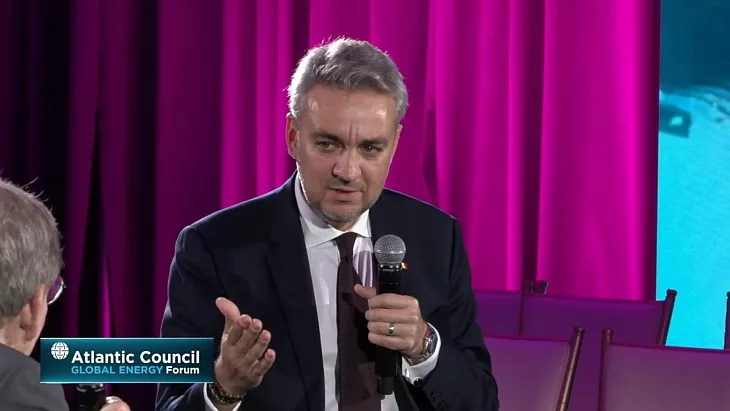
Romania has a strategic position in the energy architecture of South-Eastern Europe, but its geography and energy potential must be turned into concrete, feasible and protected projects. This was the message delivered by George Niculescu, President of the Romanian Energy Regulatory Authority, ANRE, during the Atlantic Council Global Energy Forum 2026, in a panel dedicated to European energy corridors, infrastructure and partnerships for resilient energy supplies.
Energy security also means protection against disinformation
George Niculescu underlined that the risks facing energy systems can no longer be understood only in terms of military attacks against critical infrastructure. In the Black Sea region, energy vulnerability is also amplified by hybrid warfare, fake news and disinformation campaigns, which can affect public trust, investment decisions and market stability.
“I think it’s not only bombs that are dropping, drones that are hitting critical infrastructure, but we are getting hammered every day by fake news, because it’s a new type of war,” Niculescu said. In his view, energy security increasingly depends on the capacity of states and institutions to provide trust, stability and predictability. For investors, contradictory messages, legislative instability or uncertainty regarding public policy can become almost as costly as physical risks. “What’s missing, it’s a solid and predictable framework,” the ANRE President said. “Investors will not come to this part of Europe to put money unless they have a good stable framework.”
He stressed that regulators have a central role in attracting private capital: “We cannot talk about resilience, we cannot talk about more grids, more pipelines unless we have good and stable framework.”
Maps and announced projects are not enough: feasibility is essential
One of George Niculescu’s recurring messages was that the region needs to move from presentations, maps and intentions to projects that are actually delivered. Strategic energy infrastructure does not become relevant simply because it is drawn on a map, but because it has a regulatory framework, an economic model, appropriate tariffs, financing and functional partnerships.
“In rooms like this too many times we have presented projects maps in which we are drawing lines,” Niculescu said, referring to how natural gas routes or compression points are often described in public discussions. “It’s not enough. I mean we need to have projects, but projects will get alive, will see the daylight if we have good framework.”
He mentioned the Vertical Corridor as an important example. Romania is in the middle of this route, which enables natural gas to move from south to north, including towards Ukraine and other markets in the region. To support the feasibility of the project, Romania contributed by lowering tariffs so that gas molecules could move along the corridor. “What we did to make this project feasible was to lower down rates in order for the molecules to move along this Vertical Corridor.”
However, his message was that more needs to be done. The strategic partnership with the United States, including in nuclear projects and technologies such as small modular reactors, must be focused on concrete results.
A strategic role in the Black Sea, in supporting Moldova and Ukraine, and in regional reconstruction
George Niculescu insisted on the importance of Romania’s geographic position. Romania does not have Germany’s industrial weight or France’s nuclear fleet, but it has a major strategic advantage: its location on the Black Sea and its role as an entry point for regional energy flows.
This role is relevant in several directions. First, Romania is essential for projects bringing energy from the Caucasus and the Caspian area towards Europe, including the green corridor that would carry energy through Georgia and under the Black Sea. Second, the Black Sea offers both natural gas resources and significant offshore wind potential. “These assets must be protected,” he added, arguing that NATO and partner countries should contribute to securing critical infrastructure projects in the region.
Romania is already playing a concrete role in supporting its neighbors. Niculescu recalled that Romania has helped keep the Republic of Moldova supplied with energy in recent years and that, for the first time in many years, natural gas has flowed to Moldova from the west, not from the east. “We are keeping the lights on in Republic of Moldova for around four winters now,” he said.
In Ukraine’s case, Romania is providing energy support and acting as a transit country for electricity coming from other parts of Europe. “Romania is a transit country for electricity from other parts of Europe to supply to Ukraine,” Niculescu said, noting that Ukraine’s energy infrastructure continues to be targeted by massive attacks.
In addition, the Port of Constanța, the largest maritime port on the Black Sea, could become an important base for Ukraine’s reconstruction once the war is over.
Natural gas and the energy transition go side by side
During the discussion, the ANRE President rejected the idea of a rigid opposition between the role of natural gas and the energy transition. In Romania’s case, the two directions should advance together.
“In Romania, these goes side by side,” Niculescu said. “Romania is the largest natural gas producer in European Union and from 2027 the project Neptune Deep will be online and we will actually be exporting energy security to the countries in the region,” he said.
Black Sea gas can contribute to supply diversification, reduce regional dependencies and support market stability. At the same time, Romania continues to invest in the energy transition. “In parallel with this we will keep investing in energy transition,” he said. “Seven gigawatts of renewable are deployed in Romania and on top of that 2 gigawatt of storage capacities by the end of the year will be online as well.” For a system with a growing share of renewable sources, storage becomes essential for balancing, flexibility and operational security.