


The Alba Local Energy Agency (ALEA), a partner in the European consortium of the LIFE IN-PLAN project, presented the results of the implementation of the IN-PLAN methodology in Romania at a national dissemination conference. The event brought together over 30 representatives of local and central authorities in a discussion on how energy, climate, and spatial planning can be better integrated into local administration and future urban planning documents.
The LIFE IN-PLAN project, co-funded by the European Union, aims to increase the capacity of local authorities to integrate energy and climate objectives into existing spatial planning systems. In Romania, ALEA coordinated collaboration with urban planning departments and chief architects to bridge the gap between climate and energy strategies, including PAEDC/SECAP, and General Urban Plans.
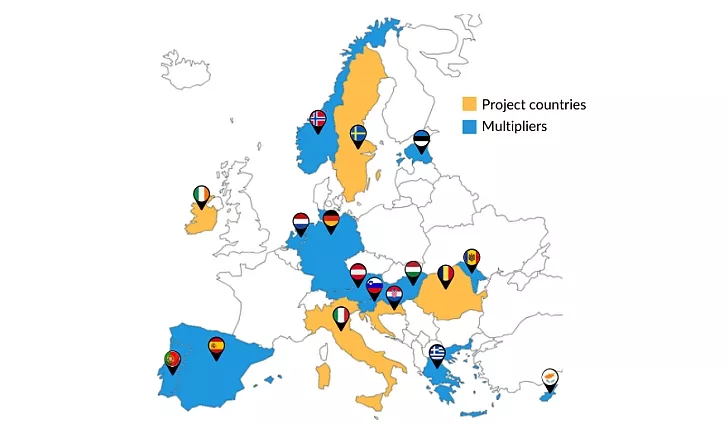
The implementation was carried out in two categories of localities. Alba Iulia, Cluj-Napoca, and Sebeș served as flagship cities, participating in the co-creation of the IN-PLAN procedure and the integration of sustainability criteria from the stage of drafting the specifications for the new PUGs. Abrud, Oradea, Târgu Mureș, Tulcea, and Râmnicu Vâlcea were included as pilot cities, benefiting from technical mentoring on topics such as low-emission zones, energy efficiency, and the correlation of climate measures with local planning.
The benefits for local governments include strengthening institutional capacity, better interdepartmental collaboration, and reducing duplication of analyses carried out separately by urban planning and energy and climate departments. In addition, integrated planning can more clearly link development decisions to local and regional budgets and investment priorities.
The final project report shows that one of the recurring problems at European level is the separation between energy and climate plans and spatial planning instruments. Under these circumstances, climate objectives often remain at the strategic level, without being directly translated into applicable territorial provisions. IN-PLAN was designed precisely to fill this gap, not by proposing a new planning instrument, but by strengthening existing ones and directly integrating energy and climate objectives into them.
The methodology is structured in five stages: organizing the integrated process, basic analysis, defining a vision and common objectives, the planning phase, and monitoring. A central role is played by the IN-PLAN Checklist, a tool used to identify synergies and inconsistencies between spatial planning, mobility, climate adaptation, and renewable energy.
For Romania, the report explicitly mentions the case of Alba Iulia, where the methodology supported the integration of energy performance criteria into development documentation and procurement processes. For the B2B market, this is a relevant signal: integrated planning not only influences local strategies, but also how projects are prepared, requirements are defined, and investments are prioritized.
Conference participants supported the continuation of the initiative through an IN-PLAN National Coalition Group, designed as a structure to support and promote integrated planning, including in the context of the application of the new Urban Planning Code in Romania.