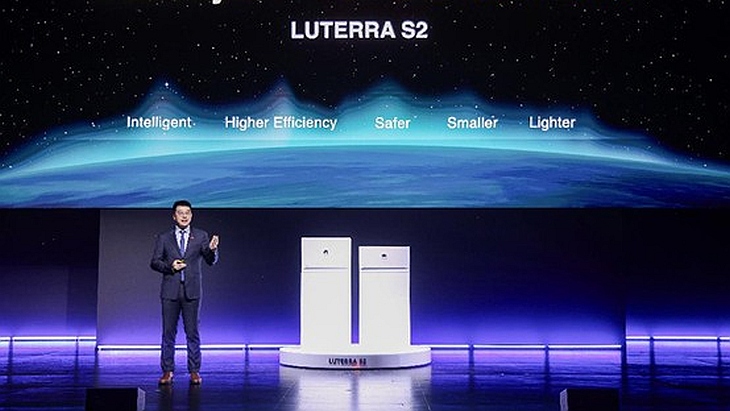
It was no coincidence that Huawei chose Palma de Mallorca to unveil its new Luterra S2 residential storage system to the press and its partners: the prosumer segment is growing, and solar energy has become increasingly vital for reducing utility bills. Palma de Mallorca offers abundant sunshine, making it the perfect setting to demonstrate how these new systems function. According to Huawei, these modular systems are exceptionally easy to set up-taking only a few minutes-and feature a compact, purpose-built design that simplifies installation. Furthermore, their high degree of modularity serves as a key competitive advantage.
We asked Huawei’s engineers what the Luterra S2 is and when it will be available in Romania.
They describe the Luterra S2 as an “all-in-one residential energy system that integrates a hybrid inverter, energy storage, and AI-driven energy management into a single modular unit.” In Romania, it will initially be available for single-phase systems, with three-phase versions to follow next year.
“Designed for easy installation, the Luterra S2 can be mounted and commissioned in just a few minutes. Available in single-phase (3-10 kW) and three-phase (5-20 kW) configurations, the Luterra S2 is the industry’s first all-in-one residential energy system built on Huawei’s proprietary full-SiC (silicon carbide) architecture, delivering exceptional efficiency, power density, and reliability,” they state. The system is designed to lower utility bills; it is intelligent and will assist prosumers-especially once variable tariffs become available, among other benefits. It can anticipate costs, consumption peaks, and weather conditions. Consequently, it helps reduce expenses and utility bills where applicable, and can facilitate drawing power from the grid during periods when prices are low.
“We are thrilled to launch the HUAWEI LUTERRA S2, our next-generation all-in-one residential energy system,” stated Steve Zhang, President of Huawei’s Distributed PV & BESS division, during the launch conference. “By combining a full-SiC architecture, AI-driven energy management, and industry-leading safety standards, the LUTERRA S2 has been designed to be more compact, lighter, quieter, safer, smarter, and more powerful than ever before.”
As solar energy, energy storage, electric vehicle charging, and home energy management increasingly converge, homeowners are seeking solutions that offer not only power and capacity but also greater intelligence, efficiency, and safety.
A comprehensive experience: from core technology to daily use
The LUTERRA S2 combines high power density with a compact design, delivering 20 kW-class power in an elegant form factor. Thanks to its proprietary full-SiC architecture and ANPC (Active Neutral Point Clamped) topology, the system achieves an efficiency of up to 99%. Integrated energy optimizers enable a lifetime yield of up to 5.0 MWh per kWh of capacity, with a design life exceeding 15 years.
Beyond its technical performance, the LUTERRA S2 is designed to integrate seamlessly into modern homes. Its art-inspired aesthetic, Red Dot Award-winning hardware, the App 3.0, and an intelligent “breathing” indicator light create a harmonious blend of technology and lifestyle.
It is the industry’s first 20 kW-class system featuring fully natural cooling, which eliminates the need for external fans and keeps operating noise below 29 dB.
Ultimate intelligence: From automation to proactive decision-making
Powered by the AI Energy Management 2.0 platform, the LUTERRA S2 leverages artificial intelligence for energy planning, operation, and value optimization.
By integrating weather forecasts, electricity prices, household consumption patterns, and system status, the platform intelligently coordinates photovoltaic systems, energy storage, electric vehicle charging, heat pumps, and virtual power plants (VPPs). This coordination maximizes the value of every kilowatt-hour produced, stored, and consumed.
For homeowners, the AI assistant transforms complex energy management into simple, conversational interactions, enabling users to easily make informed energy-related decisions. For installers, AI-powered 3D modeling streamlines planning and design by identifying roof structures and installation environments. AI-driven diagnostics and remote support further enhance operational and maintenance efficiency.
Complete safety: from cell-level protection to end-to-end safety
Safety is integrated into every layer of the LUTERRA S2, from the battery cells to system-level operation.
Each battery cell features an independent protective isolation structure, supported by Huawei-developed safety components and a design that limits propagation at the local level, helping to manage thermal risks. An intelligent smoke-venting channel design enables controlled pressure release, smoke evacuation, and cooling, while continuous temperature monitoring at the AC and DC terminals ensures proactive detection and protection of critical connections.
The LUTERRA S2 has been validated against the relevant requirements of the EU Battery Regulation and complies with key international standards, including IEC 63027 for arc-fault circuit interruption (AFCI). It also underwent TÜV Rheinland safety testing-including a thermal runaway test at the cell level, a 20-minute fire test at 1,000 °C, and an explosion test involving 20% hydrogen-as well as UL 9540A validation.