

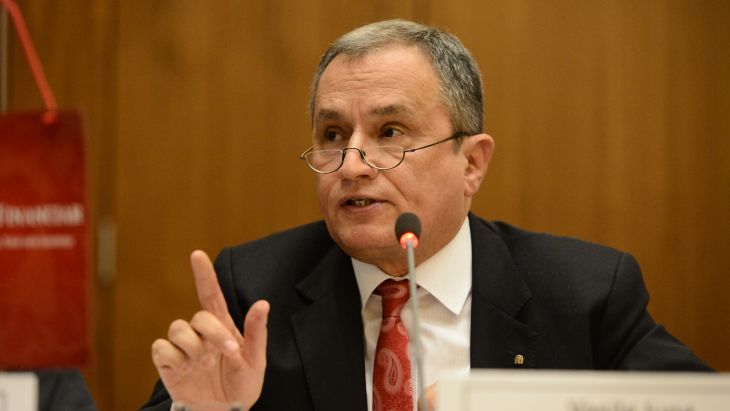
Romanian industry requires long-term bank financing to develop new production capacities, upgrade technology, and invest in its own energy generation-especially given that high energy costs are undermining the competitiveness of these companies, stated Vasile Iuga, an independent non-executive member of Alro’s Board of Directors, on Monday.
“We look to the banking sector to provide stability and predictability-primarily through multi-year facilities that span full market cycles. Furthermore, we need the banking sector to offer a broader range of risk management tools, including hedging against raw material price volatility, currency fluctuations, and interest rate risks. We view the banking sector as a partner; for instance, the recent 260-million [euro/currency unit] financing deal-signed with five banks and coordinated by BCR-demonstrates that the banking sector can indeed support Romania’s large-scale industry during challenging times. That is a remarkable achievement,” said Vasile Iuga, as quoted by Agerpres.
He emphasized the necessity of financing industrial investments, including those aimed at reducing reliance on energy purchased from the open market. “We all-the entire industry-seek long-term financing for new capacity, for technological upgrades, and even for on-site energy production facilities. This is because one of Europe’s major failures lies in the structure and operation of its energy market, which has resulted in prices for industrial consumers that are at least twice as high as those in the United States,” Iuga explained, according to Agerpres.
According to him, Romanian companies should benefit from greater involvement by banks in projects supported by grants and funding from international financial institutions.
“Certainly, we would like to see more co-financing for grant-based projects. We would also like to see local banks-in collaboration with their parent institutions-become more engaged in projects backed by international financial institutions, specifically the EIB and the EBRD. For nine years, ladies and gentlemen-in a personal capacity, representing neither the Romanian state nor any employer-I served on the Audit Committee of the European Investment Bank, a body with significant power and authority. Over those nine years, through 11 meetings annually-each lasting three days-I was able to observe how things are done elsewhere,” the Alro representative noted.
In this context, Iuga suggested that Romania is failing to fully capitalize on the financing opportunities offered by the European Investment Bank in partnership with commercial banks. “Turkey, for instance-which is not a member of the European Union-has received a total of nearly 50 billion in funding from the EIB. Poland, through various channels, has secured over 40 billion in EIB financing.
Therefore, I believe we are not attracting enough funding in partnership with the EIB and local banks-neither for SMEs nor for large-scale industry,” he argued.
He also drew attention to the difficulties faced by energy-intensive industries.
“We also believe that energy-intensive industry is the most vulnerable, given the lack of access to competitively priced energy. That is why we consider it essential to finance projects that allow energy-intensive industries to build their own energy sources,” added Vasile Iuga.
Aluminum producer Alro has signed a syndicated credit facility worth $260 million, coordinated by Banca Comercială Română (BCR), aimed at securing working capital and supporting the continuation of its development plans.
According to a company press release published Thursday on the Bucharest Stock Exchange (BVB), the facility has a three-year term. The banking syndicate includes Exim Banca Românească, Banca Comercială Română, CEC Bank, Banca Transilvania, Raiffeisen Bank, and Intesa Sanpaolo Bank.